OLYMPIA, WA – With the state facing another budget shortfall, the Environmental Priorities Coalition (EPC) expressed deep disappointment that the Legislature failed to make significant progress on major environmental priorities this session. Even worse, following the governor’s proposed budget tapping Climate Commitment Act (CCA) dollars to free up the state general fund, the Legislature approved a final budget that uses $546 million in CCA funding on complicated budget tricks to fill budget gaps.
In the wake of this historic shift of dedicated environmental funding, the Legislature’s new budget assumes paying back this funding diversion in the next 2-year budget (2027-29). CCA dollars are expected to decline in coming years, and the environmental community will work hard to ensure climate dollars are paid back to keep the state on track with its climate goals.
In a difficult budget year, one significant victory was the restoration of funding for wildfire response and resilience – $60 million to reverse the cut in last year’s budget and to continue critical proactive work to address the growing wildfire and forest health crises. In addition, lawmakers closed loopholes so that data centers must meet state clean energy standards.
Besides the budget falling short on climate, two other Environmental Priorities Coalition (EPC) priorities failed to pass. An ambitious data center bill (HB 2515) faced stiff opposition. The data center legislation is related to a growing local and national concern around ratepayers left picking up the tab including higher energy costs and diminished water resources. The bottles and cans recycling bill (HB 1607), ran out of time and will have to wait for next year. The bill would have required a refundable deposit on these items, the goal being less litter and a greater incentive to recycle thus creating cleaner, separated waste streams.
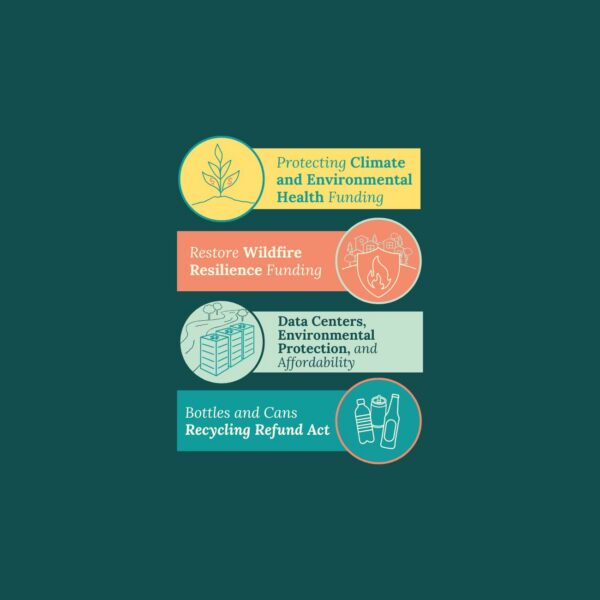
Here are the 2026 EPC priorities and how they fared:
Protecting Climate and Environmental Health Funding
Gov. Bob Ferguson’s proposed budget replaced general fund dollars for the Working Families Tax Credit with $569 million from the Climate Commitment Act. In the final budget, the Legislature took a similar approach but instead of the Working Families Tax Credit, it focused $546 million in CCA dollars to replace bond funding for natural resources. In 2021, the CCA was passed to make polluters pay for their emissions and use those funds for climate projects that help communities and ecosystems and create jobs. A large majority of voters upheld the law when it was challenged in 2024.
Diverting climate funds will devastate investments in climate pollution reduction and community protection. Since CCA funds are projected to decline as emissions decline, the state won’t be able to “catch up” later unless diverted funds are replaced. The Legislature’s new budget assumes paying back CCA funding in the 2027-29 budget, and the environmental community will work hard to ensure the promise of restored climate funds becomes a reality.
“Climate change doesn’t take a break because times are hard. The impacts from years of delay and inaction are being felt today and will continue to be felt for decades,” says Darcy Nonemacher, government affairs director for Washington Conservation Action. “It’s imperative that the governor and the Legislature pay back the CCA money they took so we can get back on track reducing climate pollution, lowering costs, and supporting communities.”
Restore Wildfire Resilience Funding
In 2021, the state Legislature passed HB 1168, committing $125 million each biennium to meet the challenges of wildfire through 2029. These investments are working. They support firefighters’ ability to better manage fire. They have improved the health of nearly 90,000 acres of forests. They invest in community-led solutions for wildfire resilience. The budget proposed last year would have cut this funding in half. That funding has been restored in the supplemental budget, a meaningful win despite diminishing climate and environmental investments in other aspects of the budget.
“”Restored funding for wildfire resilience is a bright spot in a tough session. We are grateful to the Legislature for reaffirming the commitment they made in 2021 to take a proactive approach to wildfire and forest health,” says Skippy Shaw, Washington state government relations director for The Nature Conservancy. “These investments are proven to protect communities and forests, and with this recommitment we can continue the great work happening in communities all across the state.”
Data Centers, Environmental Protection and Affordability
Data centers have the potential to profoundly impact our climate and clean energy goals, energy affordability and reliability, the environment, and communities.
The EPC backed two sets of data center bills. One (HB2515/SB6171) was an ambitious and comprehensive bill that would have ensured that data centers pay the full cost of their energy usage, disclose data center water and energy use, and charged a data center fee to support energy bill assistance, weatherization, and home electrification for low income households, among other provisions. This bill made significant progress, impressive for a first-year bill of this magnitude. However, it did not get to the finish line. The data center issue is not going away, of course, and the matter is sure to be introduced in next year’s session.
The second set, (HB 2245 / SB 5982), closed loopholes to ensure that Washington’s 100% clean energy law applies to all electricity used by data centers in Washington. That bill passed.
“At least the Legislature shored up the floor that data center energy use should meet the state’s clean energy law,” says Zachariah Baker, regional and state policy director for NW Energy Coalition. “But much more action was needed to protect the environment, affordability, and grid reliability in the face of rapid data center growth. HB 2515 would have delivered that needed action and is a missed opportunity to protect utility customers and the environment.”
Bottles and Can Recycling Refund Act
Beverage containers, a large component of our state’s waste, litter Washington’s freeways, our waterways, and our public spaces. Only 30% of beverage containers are currently recycled in the state.
The Bottles and Cans Recycling Refund Act would require people to pay a 10-cent deposit on most beverage containers and be refunded that 10 cents back when they bring containers to convenient drop-off locations to be recycled or reused. This would reduce litter as has been shown in bottle bill states across the US. In addition, in tandem with last year’s Recycling Reform Act, Washington could realize significantly increased recycling rates if a bottle bill were to pass. The bill did garner support this year, but ran out of time in this short session. “We are disappointed that the Bottles and Cans Recycling Reform Act (HB 1607) did not pass this year, but solid progress was built. We were able to engage with a large number of legislators about the benefits of bottle bills for litter reduction and increased recycling, as demonstrated in other states,” says Heather Trim, executive director of Zero Waste Washington. “Washington has been a leader in reducing waste, and especially plastic pollution, and we look forward to a vigorous discussion of this bill and others next year.”