Native Vote Washington
Increasing Native power through empowering Native voters
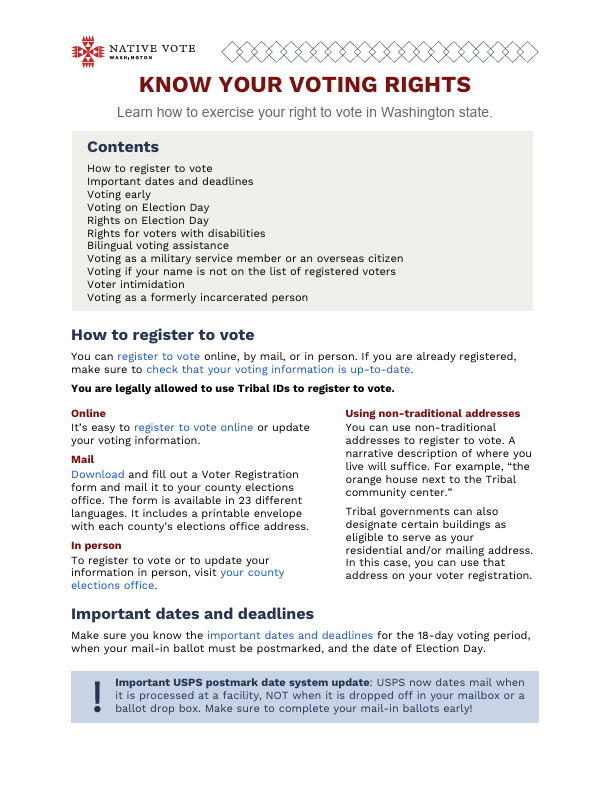
You can register to vote online, by mail, or in person. If you are already registered, make sure to check that your voting information is up-to-date.
You are legally allowed to use Tribal IDs to register to vote.
Register to vote or update
your voting information through the Washington State Voter Registration Portal.
The registration page is also available in:
Download and fill out a Voter Registration form and mail it to your county elections office. The form is available in 23 different languages. It includes a printable envelope with each county’s elections office address.
To register to vote or to update your information in person, visit your county elections office
You can use non-traditional addresses to register to vote. A narrative description of where you live will suffice. For example, “the orange house next to the Tribal community center.”
Tribal governments can also designate certain buildings as eligible to serve as your residential and/or mailing address. In this case, you can use that address on your voter registration.
Make sure you know the important dates and deadlines for the 18-day voting period, when your mail-in ballot must be postmarked, and the date of Election Day.
All eligible voters in Washington state are sent a mail-in ballot. Ballots have pre-paid postage (stamps are not required). You have two options to return your ballot:
You can vote in-person at a voting center during the 18-day voting period. Accessible Voting Units are available at voting centers.
On Election Day, you can vote in-person at a polling place until 8:00 p.m. If you are in line before 8:00 p.m., you have the right to vote. Find your closest polling location. Accessible Voting Units are available at these locations.
In Washington state, you will be asked to sign a ballot declaration. If your signature does not match your voter records, you may be asked to show a photo ID.
Common forms of photo ID include:
Learn more about Washington state ID requirements.
Tribal IDs can be used for voting even if there is no expiration date or street address.
English
1-866-687-8683
Spanish
1-888-839-8682
Arabic
1-888-274-8683
Bengali, Cantonese, Urdu, Korean, Mandarin, Tagalog, or Vietnamese
1-844-925-5287
If you are still in line when the polls close, stay in line. You still have the right to vote. If you make a mistake on your ballot, ask for a new one. If the voting machines are down, ask for a paper ballot.
If you run into any problems or have questions on Election Day, call the Election Protection Hotline.
You can also message via iMessage, WhatsApp, or Facebook Messenger.
All polling places for federal elections must meet all of the Americans with Disabilities Act (ADA) requirements. Curbside voting is not enough to meet these requirements. See the ADA requirements checklist for more information.
In Washington state, every county must have at least one accessible voting unit at each voting center. AVUs are available during the 18-day voting period. They must be wheelchair-accessible and allow for voters to vote independently and privately.
AVUs present your ballot on a monitor. You can select your choices with the touch screen or by using a wheel or other tool. You can use headphones to listen to the text. Most AVUs are also compatible with sip-and-puff tools.
If you are not able to enter your polling place because it is not fully accessible, ask poll workers for curbside assistance. Make sure to call the Election Protection Hotline to report the issue.
Federal law states that voters with disabilities and voters who have difficulty reading or writing English have the right to receive in-person assistance at the polls. You may designate a person of your choice (or two election officers) to enter the voting booth with you to record the votes on your behalf.
The designated individual cannot be your employer, an agent of your employer, or an agent or officer of your union. They must respect your privacy and not look at the ballot unless you ask them to do so.
If you bring a person to assist you, let poll workers know when you check in. You may be required to swear under oath that you have a disability and that you asked that person to help you. Your person of choice may also be asked to sign a form swearing that they did not influence your voting choices.
Election officials cannot turn voters with disabilities away from the polls with the excuse that they are not “qualified” to vote.
Tell poll workers what you need. If it is difficult for you to stand for long periods of time, they should provide you with a place to sit while you wait. If crowds or noise are difficult for you to be around, election officials can provide you with a quiet place to wait and can call you when it is your turn to vote.
If you face any challenges while voting, report the problem to the Election Protection Hotline.
Washington state complies with the Section 203 minority language provisions of the Voting Rights Act. Counties that qualify under this provision must provide registration or voting notices, forms, instructions, assistance, ballots, and other election materials in specific languages.
Washington state has four counties under the minority language program: King County, Adams County, Franklin County, and Yakima County. King County provides election information in Mandarin, Vietnamese, and Spanish; and Adams, Franklin, and Yakima Counties provide election information in Spanish.
If you live in one of these counties that provides bilingual voting assistance for a language that you speak, you can request oral assistance from a bilingual poll worker or voting materials in that language.
If you have trouble voting due to lack of fluency in English, call the Election Protection Hotline.
If you are a military service member or an overseas citizen, you have the right to vote. You can register and request an absentee ballot with the Federal Post Card Application (FPCA).
You qualify for absentee voting if you are:
For more information, go to fvap.gov/washington
You can vote as a formerly incarcerated person. However, states restore voting rights in different ways. In Washington state, voting rights are automatically restored upon release from incarceration whether you were convicted of a felony in Washington state, or in federal court.
For a misdemeanor conviction or a conviction in juvenile court, you do not lose the right to vote.
Once your right to vote is restored, you must register to vote. Even if you were previously registered to vote, you must re-register. You do not need a certificate of discharge (COD) to register to vote.
Voters are entitled to a provisional ballot, even if their name is not in the poll book. After Election Day, election officials will investigate whether you are qualified to vote and are registered. If you are qualified and registered, your provisional ballot will count. If not, your provisional ballot will not count.
First, ask the poll worker to double check for your name on the list of registered voters. If your name is not on that list, ask if there is a supplemental list of voters.
If your name is still not found, confirm whether you are at the correct polling location. You can ask the poll worker to check the statewide system (if available) to see if you are registered to vote at a different polling location. If the poll worker does not have access to the statewide system, ask them to contact the main elections office. You can also contact the Election Protection Hotline (1-866-OUR-VOTE / 1-866-687-8683) for help verifying your correct polling location. If you are registered at a different location, you will likely have to travel to that polling location to cast a regular ballot.
If the poll worker still cannot find your name or if you cannot travel to the correct polling location, ask for a provisional ballot.
If you are turned away or denied a provisional ballot, call the Election Protection Hotline.
Then report your experience to your local elections office.
If someone is interfering with your right to vote, this is voter intimidation. It is a federal crime to intimidate voters. Read more about Washington state voting laws.
Examples of voter intimidation and electoral fraud include:
If you experience voter intimidation, contact your local elections offices and report it to the Election Protection Hotline.
Learn how to exercise your right to vote in Washington state.