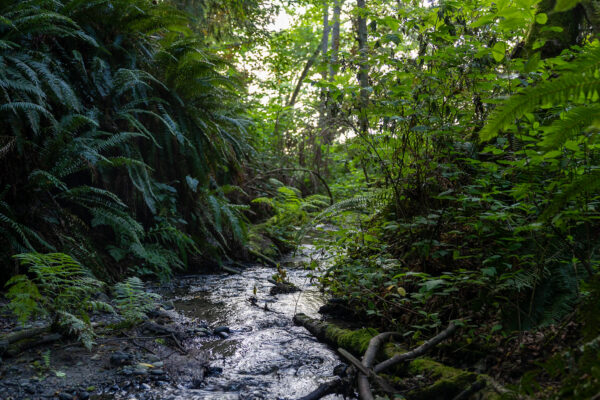
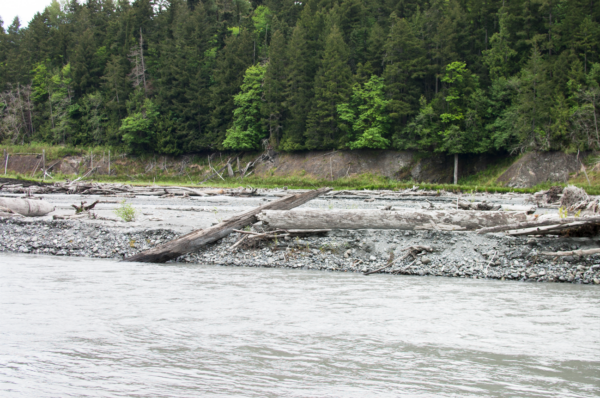
November 13, 2025—Washington just made a major decision to protect headwater streams that are critical for the health of our forests and habitat for salmon, amphibians and many other species. November 12, the Forest Practices Board voted to update the existing rule to provide much-needed larger forested buffers.
This rule is the product of decades of research through a process in which Tribes, conservation groups, agency scientists, counties, and the timber industry all designed and reviewed the science.
“Passing this rule fulfills a 25-year promise made when our state’s Forests & Fish law passed in 1999: To update the rules when the science shows a need,” explains Rachel Baker, Washington Conservation Action’s forest program director. “This will mean healthier forests, healthier fish, healthier communities.”
The updated rule requires a wider, continuous 50- to 75-foot forested buffers along streams in the forested landscape in Western Washington classified by the Department of Natural Resources (DNR) as “Type Np.” Type Np streams are non-fish bearing streams that flow year-round. There are over 19,000 miles of these streams in Western Washington which make up nearly 80% of stream lengths. Until now, logging has been allowed up to the streambank along 50% of the length of a Type Np stream.
These headwater streams are largely high up in the mountains, run year-round, and don’t contain fish. Yet these waterways play an essential role in supporting fish by flowing into their habitat downstream.
Once water temperatures warm up, it is virtually impossible to provide clean, cool streams salmon need. It also places a heavier burden on downstream communities and farms to meet water quality standards. Thus, protecting these headwaters protects everything downstream: salmon and other fish, amphibians, wetlands, deltas, orca and more.
What will be the benefits of these 75-foot buffers? These stretches of retained forest filter sediments and stabilize soils. They also provide shade that keeps water cold, which is necessary both for salmon and for healthy ecosystems. This cool water is necessary to achieve our state’s water quality commitments and our commitment to Tribal treaty rights to fish. These buffers will also support forest microclimates that help make our state more resilient in the face of climate change.
For decades, protection of these types of streams has been too weak, letting timber companies benefit while the public subsidized the costs of degraded water and ecosystems. The new logging restrictions will impact less than 1% of all forests in Western Washington but will protect a much larger network of ecosystems that rely upon them.
The state’s Adaptive Management Program (AMP), which developed the rule, brings together landowners and industry, Tribes, state agencies, counties, and conservation groups. Together, these groups identify information needs, conduct research, and develop new rules based on the results.
Washington Conservation Action has been part of this work from the very beginning. We were a signatory to the 1987 agreement that led to the AMP, with the goal of establishing science-based buffers protecting riparian habitat. Today, we lead the Conservation Caucus of the AMP.
Your donation ensures a sustainable future.