The decision preserves science-based rule protecting more than 19,000 miles of streams.
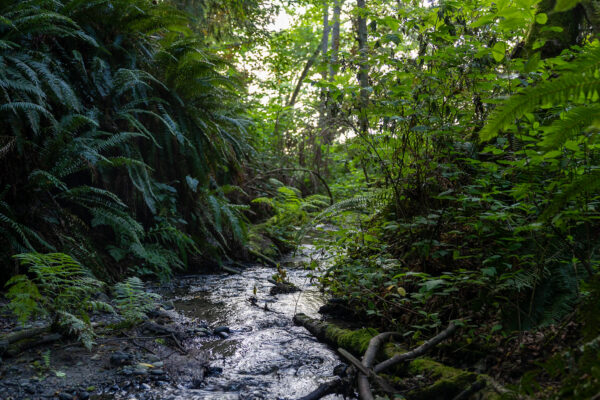
OLYMPIA, WA–Today, the Thurston County Superior Court upheld Washington’s revised science-based protections for thousands of miles of headwater streams that provide cool, clean water to downstream habitats supporting salmon, salamanders, and communities. Forested buffers along these streams regulate water temperature, filter sediment and pollutants, store water, and provide structure and nutrients important to downstream fish habitat.
The revised rule was adopted in November 2025 following more than twenty years of scientific research, independent peer review, negotiation, public engagement, and formal rulemaking. It provides continuous forested buffers of approximately 50 to 75 feet along more than 19,000 miles of headwater streams on the west side of the state to ensure streams remain cool and clean.
“Our understanding of forest and riparian systems has expanded significantly since the Forest Practices Act of the 1970s and the Forests & Fish Report in 1999,” said Rachel Baker, Forest Program Director at Washington Conservation Action. “We can feel proud that Washington has evolved our forest practices in response to new information, ensuring that forestry in our state is compatible with the state’s commitments to clean water, endangered species, and a harvestable supply of fish. Today, the court affirmed and upheld these updated protections.”
Long-term, state-funded studies found the previous rule, which allowed timber harvest up to the streambank along approximately half of these headwater stream lengths, increased stream temperatures beyond what state water quality standards allow.
“Headwater streams nourish and support downstream life,” said Dave Werntz, Science and Conservation Director at Conservation Northwest. “Decades of research showed that the old rules weren’t doing enough to keep these waters cold and healthy. The Forest Practices Board followed the science and updated the rules accordingly. Today’s decision affirms that process and protects clean, cold water for salmon, wildlife and communities downstream.”
The lawsuit, filed by timber industry organizations against the Washington Department of Natural Resources, Washington Department of Ecology, and the Forest Practices Board, attempted to overturn these science-based protections for forests along headwater streams.
The timber industry participated throughout the lengthy rulemaking, including through representation in the Adaptive Management Process. After the Forest Practices Board adopted a rule different from the industry’s preferred alternative, industry groups challenged the decision in court. The case became a test of whether Washington’s adaptive management process can deliver durable, science-based policy decisions.
Washington Conservation Action and Conservation Northwest intervened in the case to defend both the updated rule and the integrity of Washington’s collaborative science-based approach to forest management. As members of the Forests & Fish Conservation Caucus, the organizations participated throughout the Adaptive Management Program, representing conservation interests during scientific review, policy negotiations, and development of the rule recommendations ultimately adopted by the Forest Practices Board.
The rule demonstrates how Washington’s forest practices system is intended to function: identifying scientific uncertainty, conducting long-term monitoring, soliciting independent review of the results, collaboratively developing new rule alternatives, and then updating rules when evidence shows improvements are needed. This ruling affirms the credibility of the Adaptive Management Program process and the Forest Practices Board’s authority to update rules based on the best available science.
Washington Conservation Action and Conservation Northwest will continue working with partners, agencies, Tribes, and forest industry stakeholders to support implementation of the rule and advance forest management practices that protect clean water, healthy forests, and thriving salmon populations across Washington.
Washington Conservation Action and Conservation Northwest are represented by Oliver Stiefel and Kelsey Dunn of Crag Law Center, and Paul Kampmeier of Kampmeier & Knutsen PLLC.
For more information contact:
Alyssa Mayeda, amayeda@waconservationaction.org
Dave Werntz, dwerntz@conservationnw.org