TransAlta misleads on ratepayer costs and pollution as state regulator prepares to rubber-stamp project
Contacts
Alyssa Mayeda, Communications Director, Washington Conservation Action, amayeda@waconservationaction.org
Charlie McAteer, Communications Strategist, Front and Centered, charlie@frontandcentered.org
Victor Zertuche, Senior Attorney, Earthjustice, vzertuche@earthjustice.org
Sara Burleson, Communications Manager, NW Energy Coalition, sara@nwenergy.org
Robin Everett, Deputy Beyond Coal Director, Sierra Club, robin.everett@sierraclub.org
CENTRALIA, WA — Environmental and public interest advocates expressed alarm today following the Washington Department of Ecology’s (Ecology’s) announcement supporting a new natural gas power plant on the site of the shuttered coal plant in Centralia. Despite significant public health impacts and a pending air quality and environmental review, the project is being actively promoted by Ecology, the agency charged with permitting oversight.
In recent permit filings, TransAlta, a privately-owned corporation headquartered in Alberta, Canada, that has owned the plant since 2000, estimates its proposed gas-fired power plant would generate over two million metric tons of new greenhouse gas emissions each year. Emissions at that level would bring the plant into close competition with BP’s Cherry Point oil refinery for the title of Washington’s largest stationary source of climate pollution.
The plant would also be a major new source of air pollution for the region. Air quality documents filed by the company show that the facility will emit numerous pollutants and air toxics, including volatile organic compounds (VOCs), nitrogen oxides, particulate matter, and carbon monoxide. These pollutants contribute to ailments including heart and lung disease, asthma, cancer, and premature death, and are regulated under the state and federal clean air acts because of their danger to public health and the environment.
TransAlta has been the subject of numerous scandals in recent years after being found responsible for electricity price manipulation and paying for favorable research on the community health impacts of coal power plants.
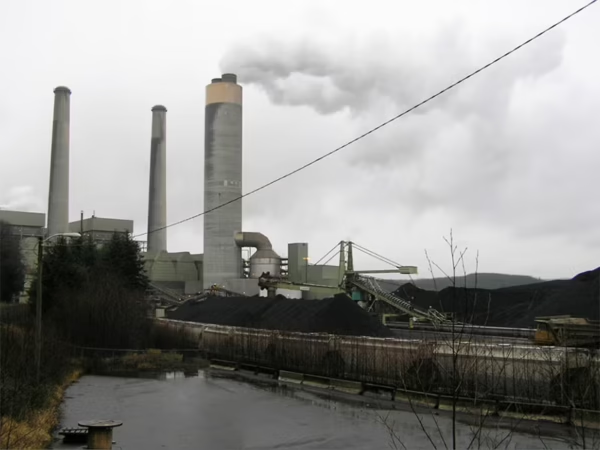
Until last year, TransAlta’s Centralia coal plant was the only remaining coal plant in Washington and one of the largest stationary sources of air pollution in the state. The facility ceased operations in December 2025 as part of a long-planned closure negotiated in 2011. Since then, the federal Department of Energy has filed and renewed three orders requiring the plant to remain operational as part of the Trump administration’s efforts to prop up expensive and dirty coal power. The Washington Attorney General’s Office and public interest advocates have challenged those orders in federal court, with the final outcome pending litigation. Despite these orders, the facility has not generated electricity since its closure, though TransAlta is still seeking recovery of millions of dollars in costs for the mothballed coal plant.
Outsized Costs for Consumers and Residents
In addition to significant pollution impacts, the project represents a major financial risk for Washington ratepayers. It’s slated to cost much more than the $600 million that has been publicly disclosed, and far above the norm for a similarly sized coal-to-gas conversion project. Puget Sound Energy (PSE) has committed to purchasing power from the new plant. However, regulators at the Washington Utilities and Transportation Commission (UTC) have not yet approved the deal, which would lock costs into customer rates for more than a decade.
PSE has included costs for purchasing power from the new gas plant in its current general rate case, in which the company seeks to increase electric rates for customers by nearly 30% over the next three years, a plan that public interest groups oppose.
Misleading the Public on Impacts and Use
TransAlta’s permit filings inaccurately compare the proposed gas facility’s future pollution to both the historical coal plant emissions and a hypothetical scenario in which the coal plant kept operating through 2035. Since the plant is not operating (and is expected to be permanently closed), there are no greenhouse gas emissions or toxic air emissions to reduce. In documents that have been shared for public review, Ecology appears poised to cosign this distorted and bad-faith accounting by the company.
Despite being billed to the public and regulators as a “peaker” plant designed to run only during times of electric grid stress, TransAlta is seeking permits that would allow the facility to run at 59% capacity—far above the threshold of a true peaking resource, typically 5 to 15% capacity, and much closer to baseload power plant operation. However, the proposed plant is too inefficient to be permitted as a baseload facility and cannot meet applicable state standards.
Public comment on the project’s environmental review documents and draft air quality permit is open through September 15, 2026.
“Washington has positioned itself as a global climate leader, but approving this expensive and dirty project as-is would move us squarely in the wrong direction,” said Julian Santos, Climate & Clean Energy Senior Manager at Washington Conservation Action. “TransAlta is deliberately misleading the public, and state regulators must commit to a robust permitting process to protect the public interest and fully consider the impacts. State agencies must not rubber stamp new fossil fuel plants without due diligence. Washington residents deserve better.”
“Frontline communities are already carrying an unfair share of environmental and climate harms caused by our reliance on fossil-fuel based energy systems,” said Aqsa Mengal, Climate and Clean Energy Policy Lead at Front and Centered. “To permit this harmful facility without adequately engaging impacted communities and meaningfully assessing health risks is not equitable and takes us further from transitioning to a clean and affordable energy future.“
“It shouldn’t be easier to build a massive gas plant in Washington than it is to build cleaner, cheaper options like solar, wind, and battery storage. A new expensive gas-fired power plant should be the option of last resort, not the starting point,” said James Hove, Washington Director of Climate Solutions. “It’s shocking to see Ecology poised to speed this high-cost, polluting gas plant through the permitting process when so many unanswered questions remain.”
“Ecology is borrowing a page from the Trump EPA playbook in its proposal to approve TransAlta’s air permit and the company’s environmental review documents,” said Victor Zertuche, Senior Attorney at Earthjustice. “TransAlta has cherry-picked its air quality data to understate the clearly negative impacts of burning more fossil gas, while concurrently overplaying alleged benefits in order to lock in expensive, inefficient investments and pass along costs to utility customers.”