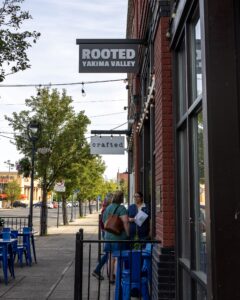
On a spring night in May, a few dozen Yakima County residents gather in a cafe in Yakima. A few days ago, many didn’t know that there was toxic contamination in communities across the state, including their own backyards, at laundromats, gas stations, waterfronts, even schools. They’re coming together to learn more, and how to take action.
“Contaminated sites leave a legacy of pollution behind,” explains Katie Byrnes, Washington Conservation Action’s Toxics and Stormwater Policy Senior Manager. Washington has a successful environmental cleanup law, Byrnes explains, which handles toxic spills and pollution not covered by the federal Superfund Act, and other laws. With the un-hip name, Model Toxics Control Act (MTCA), the Washington program has already cleaned up more than 7,000 contaminated sites across every county of the state. But each year hundreds more are identified, and thousands remain to be addressed.
Add to this that cleanup is not automatic.
“Sometimes contaminated sites languish on the list,” explains Byrnes. “Sometimes the damage happened a while ago and the liable party no longer owns the land. Sometimes, people living near the site just don’t know about the risk. And if they did, they don’t know what to do about it. And unfortunately, the process can be long and complicated.”
Some of these factors no doubt played a part in the many Yakima County contaminated sites that have yet to be addressed.
“The people we elect have an obligation to be in community with us, to listen to us,” says Maricela Santana-Walle, the Environmental Justice Coordinator for ELLA, WCA’s local partner. ELLA, which stands for Empowering Latina Leadership and Action, is a Chicana/Latina-led social justice organization focused on advocacy and leadership development to increase representation as key decision-makers. “We need to bring this to their attention.”
About three years ago, building on its advocacy in Yakima, WCA hired a full-time Yakima Community Organizer, Karina Solorio. Byrnes noticed that while some Yakima schools had lead arsenate contamination cleaned up, some others had not. That seemed like a good place to start. If community members seemed interested and agreed, then WCA could help with the process.
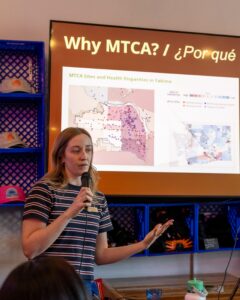
Solorio, now WCA’s Central Washington Organizing Manager, did her first presentation at Yakima Advocacy Day in 2023, explaining some of the history and the kinds of chemicals found in the soils. She also explained how this was an environmental justice issue: the schools were in neighborhoods largely BIPOC and low income. People likely didn’t know about the risks, or what to do about them. The schools not yet addressed include Eisenhower High School, Whitney Elementary School, Wilson Middle School, East Valley Intermediate School, West Valley Middle School, and West Valley High School.
“How did the pollution get there?” someone in the audience asks.
The agricultural industry creates many kinds of pollution, pesticide and fertilizer runoff, groundwater pollution from holding ponds of animal waste from dairies and more. Yakima County has all these issues, but a particularly common form of contamination is from a pesticide, lead arsenate, that was commonly used by orchards.
You can tell it might make a good poison from the roots of its name. The dangers of lead poisoning are well known; and “arsenate” uses the root of “arsenic.” The pesticide was introduced in the 1890s when Yakima was just changing into an orchard center. Every year, farmers sprayed it in liquid form or dusted their trees with it, using several pounds an acre. Then, in 1947, a new pesticide DDT (which has its own problems) replaced lead arsenate. The Environmental Protection Agency (EPA) did not finally ban lead arsenate until 1988.
“Do the lead and arsenic stay in the soil?” an audience member asks.
The pollutants remain, Byrnes explains. Lead and arsenic do not biodegrade naturally in soil. They don’t filter down to the water table but generally stay near the surface. No level of lead exposure is safe, especially for children. It’s associated with behavioral problems, reduced growth, and lowered IQ. Long-term arsenic exposure has been linked to heart disease, diabetes, and a variety of cancers.
In the 2000s, the Washington State Department of Ecology (Ecology) made a big push to clean up 26 schools and two parks in central and eastern Washington, all of which had been built on former orchard lands. Ten of these were elementary and middle schools in Yakima County.
“How long will the sites be contaminated?” an audience member asks.
Essentially, Byrnes and Santana-Walle respond, it remains contaminated until it’s cleaned up. Ecology has developed four options to clean up soil contaminated with lead and arsenic on former apple orchards:
- Excavate and remove the contaminated soil. A permanent solution, but expensive, since usually large amounts of soil must be trucked away.
- Hard or soft capping. This can be a hard barrier like asphalt or concrete; or something soft like soil, grass or gravel. This is considered the most cost effective.
- Consolidate and cap. All the contaminated soil can be moved to one place on the same property, say a parking lot, and then capped.
- Mixing. Contaminated soil is mixed with deeper, cleaner soil, or soil that’s imported. This option requires rigorous testing of contamination levels in soils used.
So, what do community members do next?
Nancy Lust, who has worked on other MTCA issues in Yakima County at Friends of Rocky Top, shared how her organization told Ecology there was a problem, then they came and investigated.
“You have to be noisy and have solid evidence, now they have a liable party on the hook to clean it up,” she says. “The Department of Ecology is wonderful to work with, but you have to be persistent.”

Byrnes and Solorio share ways to get information and to take action. For instance, the Ecology website has a “What’s In My Neighborhood?” app where you can enter an address and it brings up information about nearby contaminated sites. They share simple actions residents can take to decrease their contact with arsenic and lead in soil.
“There are schools that are MTCA sites that have been known for years,” explains Santana-Walle. “Ecology needs to hear from you, and you have the power to tell them what needs to be done.”
The problem is money: In tough budget times like these, projects like this need a public campaign and legislative advocacy and support. During the session, the organizers took digital surveys to understand residents’ confidence in the state cleanup process and how they would like to engage going forward. They asked how safe people felt their environment was.
“Public participation is a core part of MTCA, so Ecology should hear from you,” Byrnes explains.
Organizers set up a station where people attending could write postcards provided by WCA and ELLA. Lots of people submitted postcards asking for action on these contaminated sites and sharing their personal connection to the issue. The mailbox for them was overflowing by the end. And thus, another grassroots campaign begins.
What’s In Your Neighborhood? View toxic sites near you.